

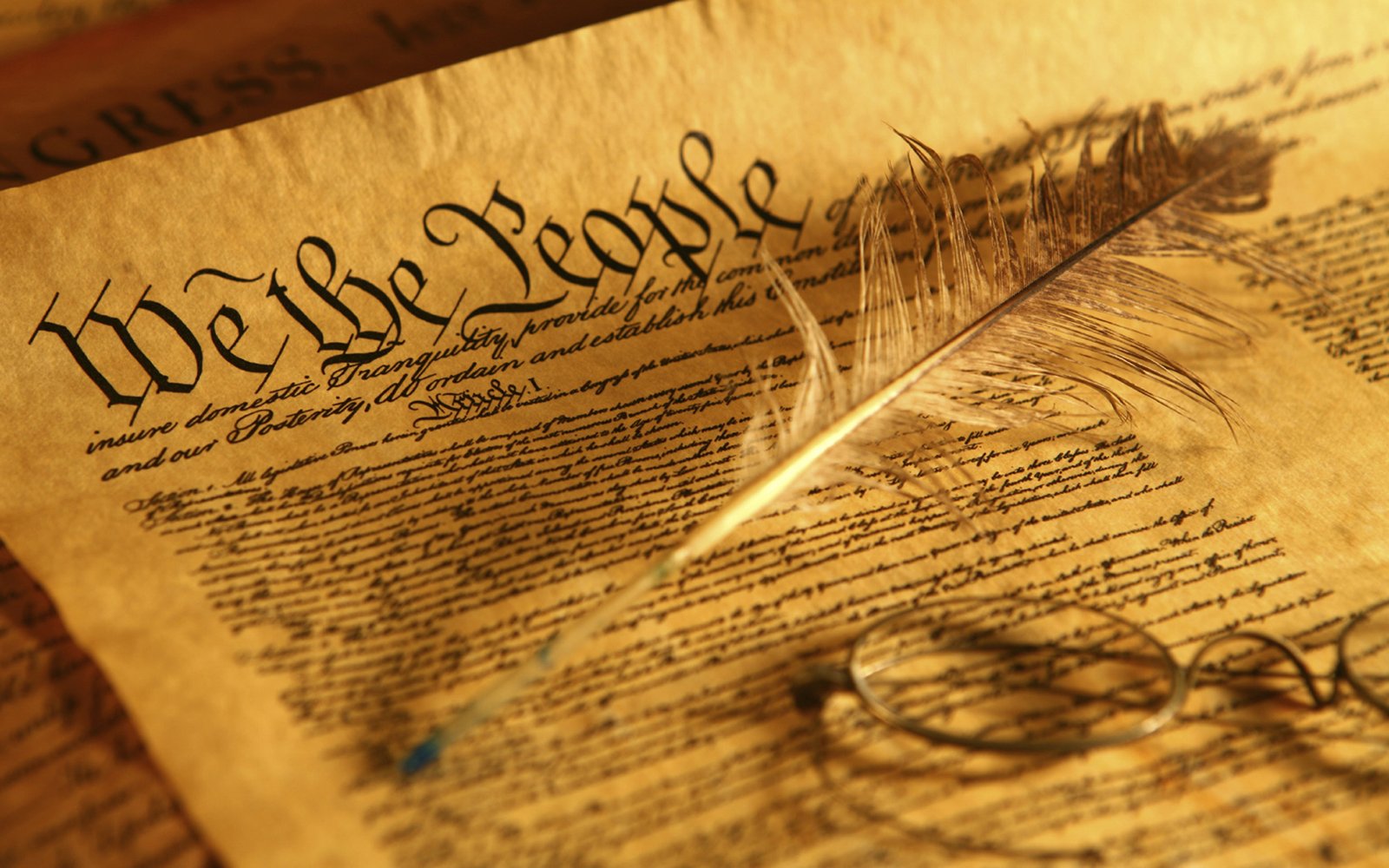
The U.S. Constitution is the supreme law of the United States, ratified in 1788. It sets up how the federal government works, divides power, and spells out some of the (supposedly) basic rights of citizens. Think of it as the instruction manual for running a country; however, people have been fighting over what the instructions mean since day one.
Don’t let the marble statues and patriotic posters fool you: how it actually plays out in court is messy, political, and often devastating for the vulnerable.
The Structure
1. Preamble
“We the People…”
The lofty mission statement: unite the states, establish justice, keep peace, defend the nation, promote well-being, secure liberty. Lovely words. But they’re not enforceable law. You can’t sue the government because the preamble promised you “domestic tranquility.”
2. The Articles
These are the nuts and bolts:
- Article I – Legislative Branch
Two houses:
- Senate (2 per state, regardless of population).
- House of Representatives (based on population).
They control the purse, war declarations, and the fine print of your daily life.
- Senate (2 per state, regardless of population).
Congress makes the laws, but doesn’t promise efficiency. The system was designed for slow compromise, which today means endless gridlock while real problems burn in the background. On paper, only Congress can declare war, but in reality they’ve dodged that responsibility since World War II, letting presidents launch military actions while they posture on TV. The same people who can’t pass a budget on time decide whether you can get healthcare, vote easily, or live under surveillance.
- Article II – Executive Branch
The President runs this show: enforces laws, commands the military, negotiates treaties, appoints officials.
In reality: presidents often expand power way beyond what the Founders imagined.
The President is supposed to “faithfully execute” laws, not write them. But over time, executive orders and emergency powers have turned the presidency into a kind of one-man legislature. Drone wars, mass surveillance programs, even pandemic mandates — much of this stretched executive authority far beyond what the Founders imagined. The office has become less about faithfully carrying out laws and more about expanding power every time Congress can’t get its act together.
- Article III – Judicial Branch
The courts interpret laws. The Supreme Court gets the final word on whether something violates the Constitution.
This is where things like Roe v. Wade (abortion rights, 1973, overturned in 2022) and Brown v. Board of Education (ending school segregation, 1954) changed history or reversed course.
Nine unelected justices serve for life and get the final say on what the Constitution means. That’s why Supreme Court appointments are treated like political warfare. Each justice can end up shaping American life for decades: school segregation (Brown), abortion rights (Roe and Dobbs), marriage equality (Obergefell). The Court doesn’t just “interpret”; it remakes society and the people never vote them in or out.
- Article IV – States
Outlines the relationship between states and the federal government (full faith and credit, privileges and immunities, new states).
This one spells out how states relate to each other and to the federal government. Translation: your rights depend on your ZIP code. Marriage, abortion, gun laws, weed, even voting access — move a few miles across a state border and the law suddenly treats you like a different species. Politicians love yelling “states’ rights,” but only when it benefits their side. It’s less about freedom and more about picking which government gets to control you.
- Article V – Amendments
How to change the Constitution. Requires supermajority approval.
This is the Constitution’s update button, but it’s nearly impossible to push. Changing the document requires supermajorities in Congress and the states, which is why we’ve managed only 27 amendments in over 230 years. One of those banned alcohol and another repealed that ban. When the government finds it easier to police your drinking habits than to guarantee equal rights, you see how locked-down this system is.
- Article VI – Supremacy Clause (Federal Power)
Declares the Constitution the “supreme law of the land.” Federal law beats state law when they conflict. The Constitution reigns supreme.
The Constitution and federal laws outrank state laws, period. This is how desegregation orders forced states to integrate schools, and how marriage equality spread nationwide. But even this “supreme law” isn’t applied consistently. The Dobbs decision on abortion tossed the ball back to the states, showing that supremacy can disappear when the Court wants it to.
- Article VII – Ratification
This was the “how it starts” clause. Nine of the thirteen states had to approve the Constitution before it became law in 1788. That also means plenty of people ended up living under a government they didn’t vote for, governed by a document they never ratified. Democracy, but with fine print.
3. The Bill of Rights (Amendments 1–10)
In 1791, the first ten amendments were added almost immediately to calm fears of government tyranny.
- 1st: Free speech, press, religion, assembly.
- 2nd: Right to bear arms. (Today’s most controversial amendment.)
- 4th: No unreasonable searches or seizures.
- 5th: Due process, no double jeopardy, right to remain silent.
- 6th & 7th: Right to a speedy, public (jury) trial.
- 8th: No cruel or unusual punishment.
Sounds empowering but in practice, courts often say: these rights protect you from government overreach, not from violence by private people — even when the government fails to protect you from them.
4. Key Later Amendments
- 13th (1865): Abolished slavery.
- 14th (1868): Equal protection and due process. Today’s battleground for abortion, voting rights, marriage equality.
- 15th (1870): Voting rights regardless of race.
- 19th (1920): Women’s suffrage.
- 22nd (1951): Presidential term limits.
- 26th (1971): Voting age lowered to 18.
5. The Constitutional “Checks” That Fail
- Checks and Balances
No one branch can run the whole show without being checked by the others. (In theory, at least. In practice, power still pools up in messy ways.)
Good on paper, often gridlock in practice. - Federalism
Power is split between the national government and the states. That’s why state laws can differ, but federal law is the ceiling.
States can protect rights more — or less — than the federal floor. - Individual Rights
The Constitution doesn’t grant rights so much as it recognizes them and tells the government to keep its hands off.
If you do not know your rights, good luck defending them! Our government was not meant to uphold you, but its control over you. Your ignorance is vital to its power.
Where the System Fails the Vulnerable: Landmark Cases
This is where the textbook myth of “justice for all” collides with reality.
- DeShaney v. Winnebago County (1989)
A young boy, Joshua DeShaney, was repeatedly abused by his father. Child Protective Services knew, but didn’t remove him. After a brutal beating left Joshua permanently brain damaged, his mother sued. The Supreme Court’s answer? The Constitution doesn’t require the government to protect children from private violence. The state isn’t responsible, even when it knew danger existed.
Translation: we knew he was being beaten, but the Constitution doesn’t guarantee him the right to be safe in his own home.
- Town of Castle Rock v. Gonzales (2005)
Jessica Gonzales had a restraining order against her estranged husband. He kidnapped their three daughters. She begged the police to act. They didn’t. He later murdered the children. She sued, saying the police violated her due process rights by failing to enforce the order. The Supreme Court said no: you don’t have a constitutional right to police protection, even with a court order.
Translation: you followed the law, got the order, begged for help — and the government still has no legal duty to enforce it.
The truth is hidden in plain sight: you can follow the rules, report, seek court help—and still be told the government has no duty to save you.
6. The Ugly Truth Behind “Protection”
These cases reveal the government’s stance:
- Rights are mostly negative — they limit government interference, not guarantee safety.
- Protection orders? Symbolic. The Constitution doesn’t force police to enforce them.
- Domestic violence survivors and abused children are often blamed: Why didn’t you leave? Why didn’t you report?
- But in court, the government says: Even if you do report, even if you get a court order, we don’t owe you enforcement.
So the stereotype — that women don’t report or don’t try — is a lie. Women do report. Parents do seek help. The system shrugs.
What Really Counts
The Constitution is often taught like scripture — timeless, sacred, flawless. The truth is harsher: it’s a framework, full of gaps. And those gaps are where vulnerable people fall through.
Understanding the Constitution means seeing both its brilliance and its brutality. It empowers, but it also excuses abuse and abandonment. Until those gaps are closed through new laws, new interpretations, or new amendments — the promise of “justice for all” remains half-written and out-of-order in practice.
What is the true currency of humanity?
The Constitution may be the framework of government, but the true currency of humanity isn’t written into its clauses. It isn’t power, property, or paper money. It’s care — the willingness to recognize another person’s humanity and act on it. When laws excuse neglect and courts declare no duty to protect, what’s left is a system trading in abstractions while people suffer. If justice is ever to mean more than marble statues and patriotic slogans, it will only be because we’ve chosen to invest in that real currency: compassion, accountability, and the courage to stand for one another when the law refuses.